
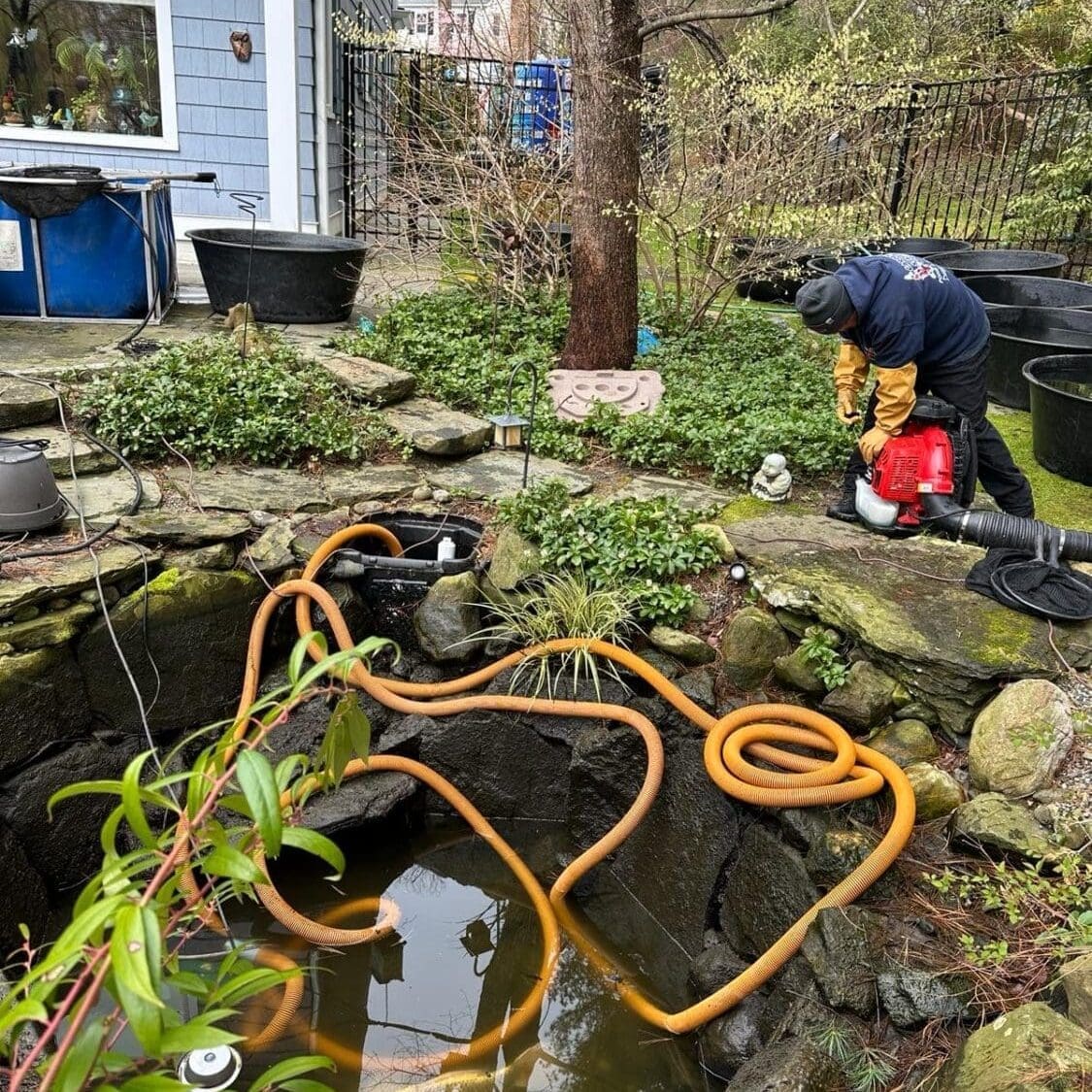
Noticing your pond water level dropping? Before you panic, it's important to determine whether you're dealing with a genuine leak or simply natural evaporation. In this guide, we'll walk you through the exact process our technicians use to diagnose and locate pond leaks — so you can save time, money, and stress.
Is It a Leak or Just Evaporation?
Every pond loses water to evaporation — it's completely normal. In the NY tri-state area, you can expect to lose about 1/4 inch of water per day under typical conditions. During extreme heat, low humidity, or windy weather, that number can climb to 1/2 to 3/4 inch per day.
So how do you know if it's a leak? If your pond is losing more than 1 inch of water per day, you likely have a leak. Track your water level over a few days by marking the waterline on the skimmer or a rock. If it drops consistently beyond normal evaporation rates, it's time to investigate.
Quick reference — normal evaporation rates:
| Conditions | Expected Daily Loss |
|---|---|
| Mild weather, low wind | ~1/4 inch |
| Hot, dry, or windy | 1/2–3/4 inch |
| Extreme heat + wind | Up to 1 inch |
| Likely a leak | More than 1 inch |
Step 1: Check the Edges
The most common cause of water loss isn't actually a hole in the liner — it's water escaping over the edges. Over time, plantings grow and push the liner down, foot traffic around the pond compacts the soil, and settling causes low spots along the perimeter.
What to look for: Walk the entire perimeter of your pond and stream. Look for wet or muddy spots in the soil just outside the liner edge. Pay special attention to areas where plants have grown over the edge — their roots can create channels for water to escape.
The fix: Gently lift the liner edge in any low spots and pack soil or gravel underneath to raise it above the water level. This simple adjustment solves the majority of "leak" calls we receive.
Step 2: Check the Stream and Waterfall
If the edges look fine, the next step is to isolate whether the leak is in the stream/waterfall or in the pond basin itself. This is the single most useful diagnostic step.
Here's what to do: 1. Turn off the pump and waterfall completely 2. Mark the current water level on the skimmer or a rock 3. Wait 24 hours 4. Check the water level
If the water level stays the same with the pump off, your pond basin is fine — the leak is somewhere in the stream, waterfall, or external plumbing. Walk the stream carefully and look for wet spots along the edges, especially at curves and where rocks meet the liner.
If the water level continues to drop even with the pump off, the leak is in the pond basin itself or in the underground plumbing. Proceed to Step 3.
Step 3: Check the Plumbing and Liner
Now we're getting into the less common but more serious possibilities.
If the water drops to the skimmer level and stops: The leak is likely at the skimmer faceplate. Check that all screws are tight and the foam gasket is intact. Over time, freeze-thaw cycles can loosen the faceplate connection. Reseal with silicone if needed.
If the water drops below the skimmer: Let the water continue to drop until it stops on its own — this tells you the exact level of the leak. Once it stabilizes, carefully inspect the liner at that waterline for small tears, punctures, or deteriorated seams.
The fix: Small liner tears can be repaired with an EPDM liner patch kit. Clean the area thoroughly, apply the primer, and press the patch firmly. For larger damage or if you can't locate the source, it's time to call a professional.
Prevention Tips
Regular inspections: Walk your pond edges monthly and after heavy storms. Look for settling, erosion, or displaced rocks. Protect your liner: Be careful with sharp tools near the pond. Keep dogs from digging near the edges. Trim aggressive plant roots that push against the liner. Monitor water levels: Make it a habit to glance at your water level daily. Catching a leak early means a simpler, cheaper repair.
Still Having Trouble? We Can Help
If you've gone through these steps and still can't find the leak — or if you'd rather leave it to the pros — our team offers professional leak detection services. We use systematic isolation testing to pinpoint the exact source of water loss, and most leaks can be repaired the same day.
Leak detection services start at $398. Call us at 845-651-4100 or visit our Repairs & Renovation page to schedule a service call.